
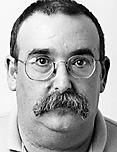
I later covered Kimura for the Star-Bulletin when he served as Big Island mayor and a circuit judge. He's one of the most decent and honorable people I've met in government - among the very best our system has to offer.
This comes up because Kimura recently added to his resume the role of poster child for members of state boards and commissions who feel put upon by the open-meeting requirements of the state Sunshine Law.
Kimura, a University of Hawaii regent, told the Senate Judiciary Committee that his innocent after-meeting discussions with fellow regents put him in technical violation of the law.
Tsk, tsk, clucked the attorney general and the state Land Board chairman. Any law that makes a stand-up guy like Kimura feel like a criminal is ridiculous. Amend it.
Wrong.
Shun, I love you man, but I don't trust even you to conduct the public's business in secret without full accountability. If you've got something to say about university business, say it so we all can hear. Let us in on the discussion.
I've covered government on the county, state and federal level in Hawaii, Washington, D.C., and several other states. Hawaii has by far the most secretive government I've seen. Officials here make it a religion to keep the public in the dark about the public's business.
Information routinely available to the public elsewhere -the police blotter, public employee disciplinary actions, computerized business registrations, motor vehicle records - is kept secret here or tangled in bureaucratic delays.
Our Legislature devotes big energy every year to bills to weaken what few laws we have protecting the public's right to know about what government is doing. Every session also produces bullying legislation to punish the media for stories that displease legislators.
So with all the ridiculous secrecy that we live with in Hawaii, let's not get too indignant about the one law that a few bureaucrats feel may be a little ridiculous in favor of openness.
State Land Board Chairman Michael Wilson said easing the Sunshine Law would make life more convenient for state board members.
Stirling Morita, our night city editor and a tireless fighter for openness as president of the Society of Professional Journalists, notes that democracy is intended to be convenient for the voting public, not governmental stewards.
For democracy to work, the public must hear the discussion as well as the decision. If board members can discuss issues privately and then vote in public with little debate, the public can't have effective input and can't evaluate what the government did when it comes time to approve or disapprove at the ballot box.
Most galling is how Attorney General Margery Bronster has cynically manipulated the open-meeting issue. She created a bogus problem and got board members all riled up by adopting the most extreme possible interpretation of the law. After making the law absurdly rigid, she says she can't enforce it.
She hints that if the news media don't get behind her on this, she may have to prosecute board members who give interviews to reporters within earshot of other board members. This could be construed as illegal communication among board members, she says.
Bronster says to give her a law she can enforce. I say to give us an attorney general who can apply a little common sense to enforcing the perfectly good law we already have.
3/23/96