Ever Green

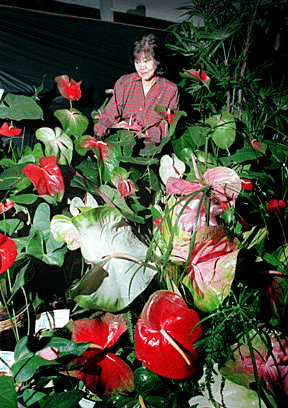
Punk anthuriums crowd the view. Photos by Ken Ige, Star-Bulletin
These are some of the products of hybridizing, the cross pollination of two different flowers. Shirley Head, president of the Hawaiian Anthurium Society, says that the best place to see what's new is at the 16th Annual Anthurium Plant Show and Sale.
The event will be held 10 a.m. to 8 p.m. April 5 and 10 a.m. to 4 p.m. April 6 at the Ward Warehouse. Admission is free. There will be workshops on the care and propagation of anthuriums at 11 a.m. and 2 p.m. both days.
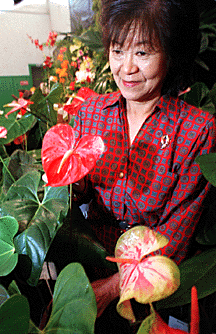
Head explained that the desired shape of the anthurium spath is a broad, symmetrical heart shape, with the two rounded parts at the top of the flower touching or overlapping. The hybrid with two spadices has been named Satan because they look like horns.
The one with two spathes, one 5 inches long and the other 2 inches long, is called Hokulea because it looked to somebody like a double-hulled canoe. Head said that collectors are intrigued, but that florists are holding off.
The five major anthurium colors are red, pink, coral, orange and white. The exception is the popular obake, which varies in shape, size and color, but is usually green plus one of the other five colors. "They love obake in Japan," Head said, and added that their export is an expanding industry here.
It could expand further if the plants weren't threatened by anthurium blight, a bacterial infection first reported here in 1961. The first symptom of the blight is the appearance of small, scattered dark spots that are more obvious on the underside of the leaves. The portion of the leaf surrounding the spots turns yellow and dies.
Once established, the bacteria spreads quickly through the whole plant. "If you bring home a blighted plant, it will wipe out your entire collection," Head said. She promised that every plant at the sale will have been carefully inspected for disease, and only healthy plants will be sold.
"When you see a blighted leaf, cut it off and throw it away," she said. 'The most important way of controlling the blight is to disinfect your shears each time you use them.' She recommends using a mixture of 10 parts laundry bleach to 90 parts water. The shears should remain in the disinfectant at least 5 seconds.
Heart-shaped blooms for sale
What: 16th annual Anthurium Plant Show
When: 10 a.m. to 8 p.m. April 5 and 10 a.m. to 4 p.m. April 6, with workshops at 11 a.m. and 2 p.m. both days
Where: Ward Warehouse
Admission: Free
While anthurium can be planted in the ground, most growers keep their collections in pots. "We used to use wood shavings as the planting medium, but now they're too hard to find. Anthuriums need a light mixture that will hold water but has good drainage. It has to be solid enough, though, to anchor the roots so the plant won't fall over."
Other planting options include macadamia nut shells, tree fern chips and volcanic cinders. "You can grow anthurium just about anywhere on Oahu, but in the dry, hot areas like Kaimuki and Ewa, you'll need shade cloth. Anthuriums want even, filtered sunlight all day. Too much sun and the leaves turn yellow," she said.
 If you live where it rains a lot, you may only have to water during dry spells. In drier areas, water in the morning so that the roots will dry out during the day. Root rot is common when drainage is poor and excess moisture is retained. Signs of root rot include small plants, small leaves and dullness of the leaves and flowers, which should be shiny.
Head recommends granular fertilizers in a mix of 5-10-10, 10-20-20 or 16-16-16, or slow-release pellets. Plants should be watered following the use of these fertilizers. Liquid fertilizers may be applied to the foliage. Watch for the first number in the fertilizer formula, which represents nitrogen.
High nitrogen fertilizers tend to shorten the life of the cut flowers, so be sure that the first number is the same or lower than the following numbers.
Anthuriums are a grower's favorite because they bloom throughout the year and the flowers last on the plant for a month.
As cut flowers, anthuriums have a vase life of about two to three weeks. Another advantage is that because they have no soft leaves to decay underwater, the water in the vase doesn't sour.
When buying cut anthuriums, Head advises that you choose those with firm necks (the area of the stem directly below the flower). "If it is firm, the flower is young. If it is soft, it won't last," she said.
Several of Head's hybrid anthuriums will be included in the sale. A retired nurse, she has named a pink one "Miss Tripler" after the color of the hospital.