Officially, the "Highland Games" began as an athletic event early in the 19th century in the wilds of north Scotland, although legend has it that an early clan leader held races among his retainers for the position of messenger, rewarding gold and swords to those who could run to the top of a nearby hill and back speedily.
The best-known of these games was called the Braemar Gathering, and it caught on in the rest of Britain, with parallel events in lower Scotland The Border Games and England The Lakeland Games. Before long, dancing and piping competition were added.
As for the sporting events, there are the standard-issue track and field competitions, plus a number of Scottish peculiarities. Most involve strength and skill, exactly the sort of sport that people used to swinging broadswords at Englishmen would adapt.
THE FACTS:
What: "15th Annual Hawaiian Scottish Festival"
When: 9 a.m. to 5 p.m. Saturday and Sunday
Where: Kapiolani Park, near the bandstand
Cost: Free
Call: 988-7872
And we're not going to get into golf here, which the Scots refined into a real game back in the 1740s right about the time Bonny Prince Charlie tried to restore the Stuarts, and tartans were outlawed by the annoyed English. There's some sort of poetic justice there.
There are a number of traditional Highland sports that aren't generally played at the Hawaii edition, including the Sheaf Toss in which a 16-pound bag of hay is stabbed with a six-foot pitchfork and flung over a crossbar more than 20 feet high and the Weight-Over-The-Bar, in which a 56-pound stone is tossed directly upward over a crossbar. Each contestant is allowed three throws at various crossbar heights, and if the bar is dislodged, the throw is a miss. These events tend to weed out the weenies pretty quickly.
At some events, such as the Stone Throw and Caber Toss, wearing a kilt is mandatory.
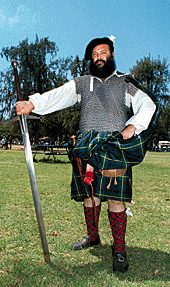 Groups such as the Society of Creative Anachronism will be present at the annual Highland Games this weekend in Kapiolani Park. The man is wearing a breacon faille kilt.
Photo by K.T. Reilly, Special to the Star-Bulletin
The athletic events themselves are taken seriously by competitors, and there's a "circuit" of Highland Games on the mainland, with the largest events taking place in remote mountain areas of the East Coast, where Scots tended to settle. Pat McLachlan of Kailua has been ranked nationally in women's events and was a regular on the West Coast circuit.
Women-only events include hurling frying pans and rolling pins. "In serious competition, the 'frying pan' is actually a circle of iron with a handle welded on," McLachlan said. "It's thrown like a discus; distance counts. We can put that baby over 100 feet!"
Here, it'll be a real frying pan, which they'll throw until the handle breaks, McLachlan said. She just had hand surgery, so the field's wide open, ladies.
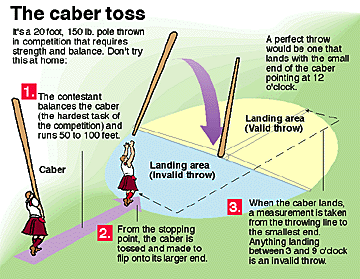
The caber is tapered so that one end is quite a bit larger than the other. The contestant jerks the caber upward with the heels of his hands and then cups his fingers underneath.
Balancing the log, he runs forward about 50 to 100 feet, allowing the big end to begin to fall forward. He then squats and, rearing upward, throws the small end as high in the air as possible. A correct throw has the big end striking the ground first and the small end passing over the fulcrum, falling beyond the big end.
A perfect throw has the pole arcing over, following the line of throw, 90 degrees to the thrower's shoulders.
Imagine the point where the big end strikes as the center of a clock, facing the thrower. A perfect throw has the small end striking 12. The small end has to strike in the 180 degrees between 9 and 3 o'clock to count (this is called a "turn"); anything in the lower face between 3 and 9 o'clock aren't valid throws.
The winner is the best of three throws, measuring the distance from the thrower to the small end. The throws are also judged on form; all other things being equal, a thrower with a small end at 11 o'clock will beat a throw with the small end at 10 o'clock.
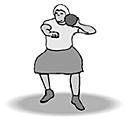 This will look familiar to anyone acquainted with the shot put. Athletes combine speed, agility, choreography and strength to hurl a roundish weight as far as possible. It requires a tremendous burst of strength from the arm at the last moment.
The weight of the stone varies from 18 to 30 pounds, depending on where the games are held, but it's always the same stone for accurate record-keeping.
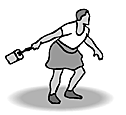 The weights are cubes of metal with rings attached, and weigh 56 pounds and 28 pounds, with an overall length each of about 18 inches. Judging is by distance the weight is thrown from behind a "trig," or toeboard.
The thrower can run up to 9 feet from behind the trig, and often spin while doing so to build up velocity. In this, it's like the discus throw. And he can't fall down after throwing.
A good throw for the 56-pounder is more than 30 feet; for the 28-pounder it's about 70 feet.
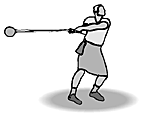 This grew, naturally, out of flinging maces at the noggins of English invaders. By the time the Highland Games came along, throwing sledgehammers was something of a national pastime. It's a good example of your avocation becoming your pastime.
Today, the hammers are 50 inches long, have a round head and are weighted in Light Hammer (16 pound) and Heavy Hammer (22 pound) classes. The thrower must not move his feet until after the hammer is thrown, usually by swinging it around two or three times before letting it fly. The Mighty Thor and Mjollnir were pikers.
Distance counts, and good throwers use their legs and hips to torque up the spins, letting gravity pull the head during the down cycle and then letting inertia loft the head skyward.