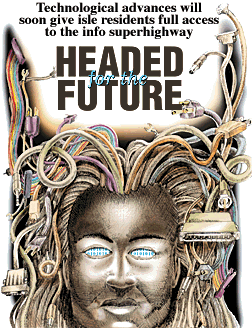
Illustration by Kevin Hand, Star-Bulletin
Headed for the future
High-tech gadgets will soon change
how isle residents communicate
By Rob PerezStar-Bulletin
Illustration by Kevin Hand, Star-Bulletin
You ain't seen nothin' yet.
By the turn of the century - only four years away - improved technology and the rapidly changing telecommunications market will dramatically redefine the way Hawaii residents use computers, telephones and televisions, industry executives say.
From their perspective, here's a hint of what the future will look like:
But the market dynamics should give rise to many new applications, some not even conceived yet, the executives say. Competition will be so keen that companies constantly will be striving to improve their service, hoping to stand out in the market.
"I think everyone is going to be looking for ways to provide it cheaper, faster or better," said Kathleen Hishinuma, Hawaii president for GTE Mobilnet.
"It's a brave new world out there," added Steve Barnes, president of Sperry Communications on the Big Island. "Consumers are in for a wild ride."
Hawaii companies already have started preparing for the brave new world.
GTE Hawaiian Tel has spent more than $900 million over the past five years to upgrade its phone system, getting ready for the onslaught of competition.
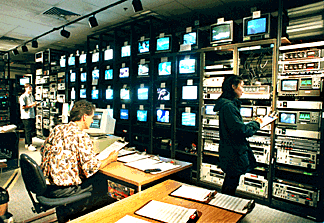
Oceanic's control room. Photo by Dennis Oda, Star-Bulletin
Many other companies are pursuing wire-based and wireless strategies, hoping to capitalize on Hawaii's changing market, which in some respects is at the cutting edge nationally.
Some critics even question whether the state is moving too fast, embracing the technology without adequately considering potential drawbacks.
Hawaii is so accepting because many people tend to be high-tech oriented with good disposable incomes, industry officials say.
That's one reason Oahu has the highest percentage of cellular phone users in the nation; one reason Oahu spends more per capita via home-shopping networks than any other market in the country.
"We are quick to accept technology mainly because there is that strong need to use technology to make life simpler and more efficient," said Eric Tom, general manager of Long Distance/USA-Sprint. "People here want it faster, demand it faster, buy it faster."