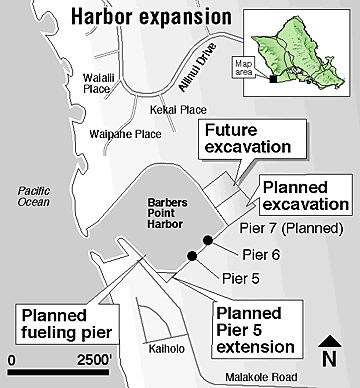
The expansion will help meet a huge increase in harbor use which has gone from 19 vessels carrying 99,145 cargo tons in 1990 to 430 ships and 2.9 million cargo tons last year.
The state plans to go out for bids in May for a job to dredge out 1.4 million cubic yards from the harbor and dig down to 38 feet deep, the depth of the surrounding waters. The largest part of this will be an area of 600 feet by 1,100 feet. There is a small triangular part also to be dredged out to 38 feet deep to extend the existing Pier 5.
The state estimates dredging costs at $16 million, funded through harbor revenue bonds to be repaid from harbor user fees.
The added berths will be the first phase of the harbor expansion. Another dig of 500 feet by 1,100 feet will be done "when the harbor needs it" but that may be 10 or 15 years from now, said Tom Fujikawa, state harbor division chief at the department of transportation. The dredging contractor should be selected by August, with dredging to start in September and completed in March 1998, he said. The construction of new piers may start in late 1997 or early 1998, he said.
For now, the department only has funds to design the new Pier 7 and a fueling pier. Estimated construction cost is $14 million. The harbor's division also needs certain approvals, including a coastal zone management permit, water resources permit from the state Department of Land and Natural Resources and the U.S. Army Corps of Engineers's approval.
Existing users of Barbers Point Harbor include major oil companies (BHP Hawaii Inc., Chevron USA Inc., Texaco Refining and Marketing Inc.), Gasco Inc., Hawaiian Cement, Hawaii Metal Recyling Co., Marisco Ltd. and Briggs Pacific Industries Inc. Bulk cargo such as petroleum products, sand, coal, gypsum, cement, fertilizer and grain is unloaded at Barbers Point, but no containers yet.
However, Aloha Cargo Transport is planning for a split-operation using both Honolulu Harbor and Barbers Point for containers, said Fujikawa. The Seattle-based company brings in construction materials and also handles cargo from military transfers.
While the big shippers who bring in containers - like Matson and Sea Land - are not considering a split-operation, or a move to Barbers Point, the long-term outlook for the harbor is more users.
The Campbell Estate has it own long-range plan for leasing land around the harbor, based on three different types of uses.
The 1,300-acre Campbell Industrial Park is for heavy industrial uses such as refineries; the 800-acre Kapolei Business Park is for light industrial uses such as warehouses; and the 63-acre Kapolei Maritime Industrial Park is for businesses that need direct access to the harbor, said Donna Goth, the estate's development director.
"We've identified 10 or 15 businesses that could use the Kapolei Business Park but I think many of them want the (harbor) infrastructure there before they come."
The first 130 acres of the business park is being marketed now, and Goth hopes that the estate can get some new kinds of businesses, possibly an "auto mall" for distributors. Since cars are brought in to Hawaii on ships, nearness to the harbor would be a plus.
Costs to develop the maritime park are unknown, said Susan Sublett, estate manager of industrial properties. "We have to figure out the costs, the timing and then go to the (estate) trustees for the funds," she said.
The earliest possible completion is late 1997 or 1998, she said.